






Nigerians Must Never Allow APC To Become ‘The Death Of Our Democracy’ — ADC Condemns Reps’ Leadership For Creating Loopholes For Electoral Malpractice In Passed Act

The African Democratic Congress ADC has criticized the National Assembly’s handling of the Electoral Act amendment, calling the proceedings disgraceful and warning that they undermine Nigeria’s democracy.
The party also criticised the ruling All Progressives Congress, APC, over the controversial passage of the Electoral Act Amendment Bill by the National Assembly.
Trouble began when the Chairperson of the Committee on Rules and Business, Francis Waive (APC, Delta), moved a motion pursuant to Order Nine, Rule 1(6) of the Standing Orders, seeking to rescind the passage of the Electoral Act (Amendment) Bill, 2025, which the House had approved in December 2025.
Waive said the motion was necessary to align the legislation with emerging electoral reforms and urged members to recommit the bill to the Committee of the Whole for reconsideration.
When the motion was put to a voice vote by the Speaker, Abbas Tajudeen, a majority voted against it. The outcome sparked protests on the floor, with members openly disagreeing, resulting in a rowdy session that lasted several minutes.
In an apparent effort to calm tensions, a separate motion was moved for the House to dissolve into executive (closed-door) session. When the proposal was put to a voice vote, lawmakers again rejected it.
Despite the resistance, the House was eventually called into a closed-door session.
After more than an hour in executive session, Tajudeen stepped aside, and the Deputy Speaker, Benjamin Kalu, presided as the House moved into the Committee of the Whole to consider a Bill to repeal the Electoral Act, 2022, and enact the Electoral Bill, 2026.
As deliberations began, Kalu took several clauses in bulk. This drew protests from lawmakers who insisted on clause-by-clause consideration. Ignoring the objections, he repeatedly struck the gavel after voice votes on grouped provisions.
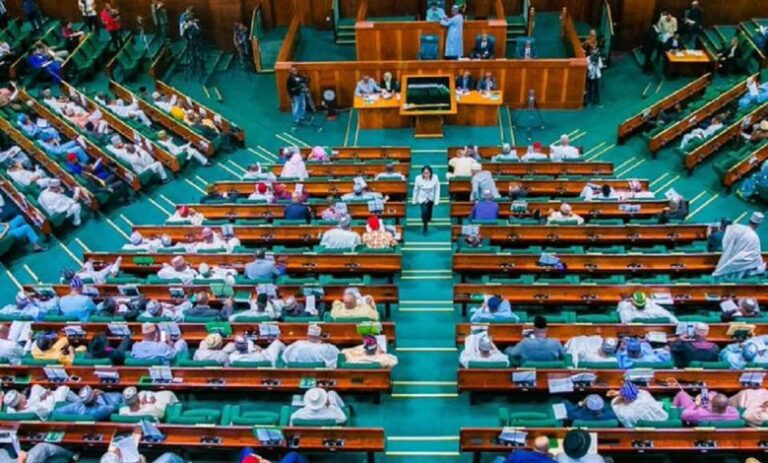
Tensions escalated as some members left their seats and approached the chair, chanting clause by clause.”
After several minutes, Kalu pleaded with them to return to their seat, assuring them that they would restart the consideration process from Clause 1 and that each provision would be considered individually, as was done during the executive session. Order gradually returned, and lawmakers resumed their seats.
At one point, a member repeatedly raised a point of order, claiming some lawmakers did not have copies of the document under consideration. Kalu cautioned members against speaking without recognition and directed that copies be shared.
Fresh disorder broke out when the Committee reached Clause 60 in reference to the controversial section on electronic transmission of results during elections
When put to a voice vote, there was a divided response: some agreed, while a majority disagreed with the clause.
However, Kalu ignored it, hit the gavel, and continued with the other clauses. This led to another rowdy session with lawmakers again approaching him and chanting, “Section 60.”
This rowdiness lasted for several minutes, stalling deliberation. Kalu again urged lawmakers to return to their seats to continue the deliberations. He thereafter opened the floor for a debate.
Bamidele Salam (PDP, Osun) proposed retaining only Clause 60(3), which mandates that the presiding officer electronically transmit the results from each polling unit to the IREV portal after signing and stamping Form EC8A.
He urged the removal of the proviso that allows Form EC8A to serve as the primary source of collation where electronic transmission fails due to communication challenges
According to Salam, the caveat was “unnecessary and contradictory.” The Minority Leader, Kingsley Chinda (PDP, Rivers), seconded the amendment.
Despite repeated objections and intermittent disorder, the Committee of the Whole concluded the clause-by-clause consideration, and the House passed the harmonised version of the bill.
Following the rejection of the amendments, opposition lawmakers staged a walkout and proceeded to the House of Representatives press centre.
Led by Minority Leader Mr Chinda, the lawmakers chanted “APC, Ole” and alleged that the process was driven by partisan interests rather than national good. Some claimed that certain members had collected money, although no names or parties were mentioned.
Reacting to the development on Wednesday, the spokesperson of the African Democratic Congress, Bolaji Abdullahi, accused the APC of undermining Nigeria’s democracy.
According to Abdullahi, the level of impunity displayed by the ruling party was troubling, warning that it should not be allowed to become “the death of our democracy.”